In A Theory of Justice, John Rawls conceived of an original position. A group of rational legislators is tasked with establishing fundamental principles of justice for the whole society, but they are separated by a veil of ignorance. The legislators do not know their future social class, gender, talents, or their own life goals. Rawls argues that it is precisely this impartiality that allows the principles they select to be considered fair, because none of these principles can be traced back to any bias rooted in the legislators’ known self-interests.
This Public Philosophy Project attempts to simplify this thought experiment. Now it is a card game that can be played repeatedly.
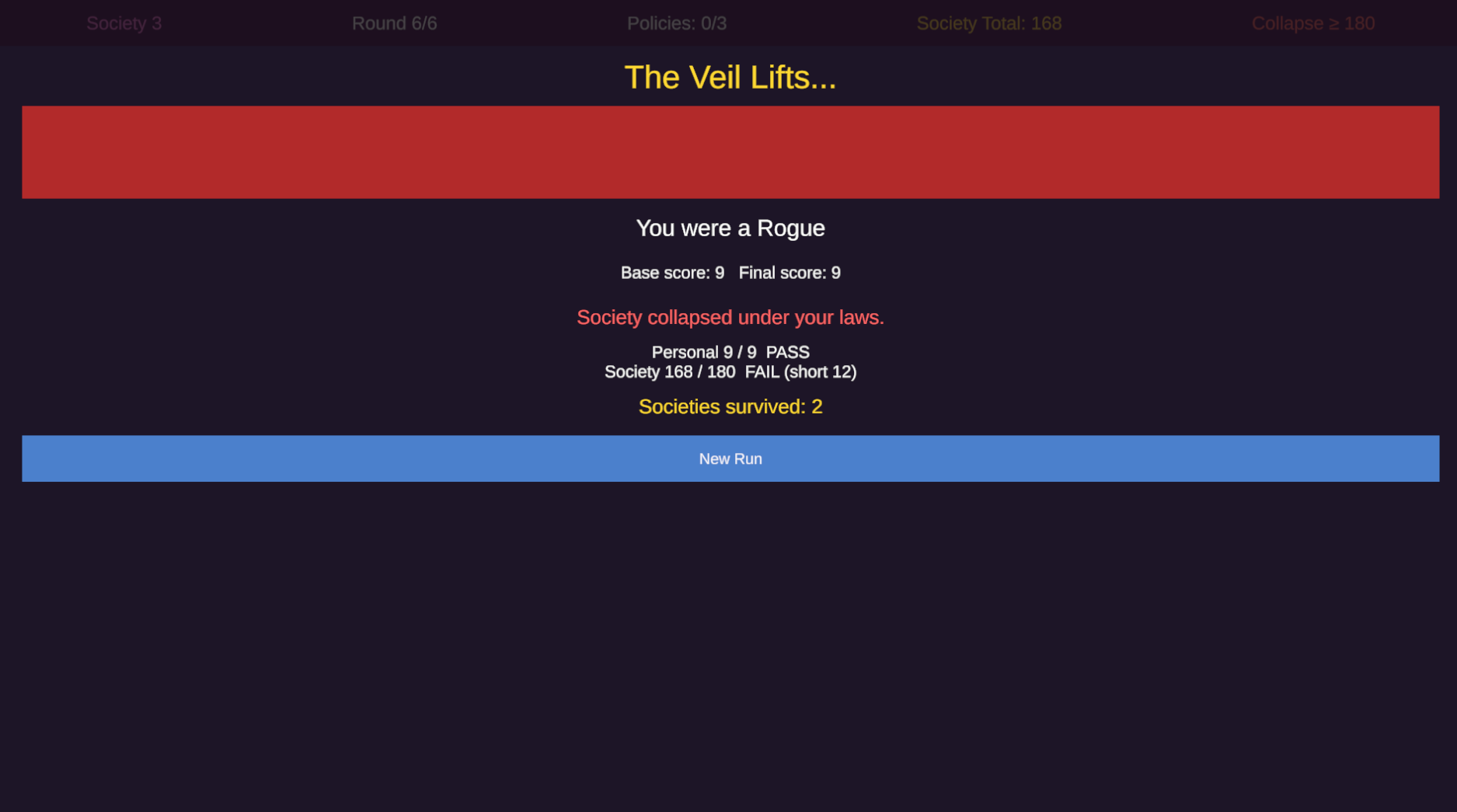
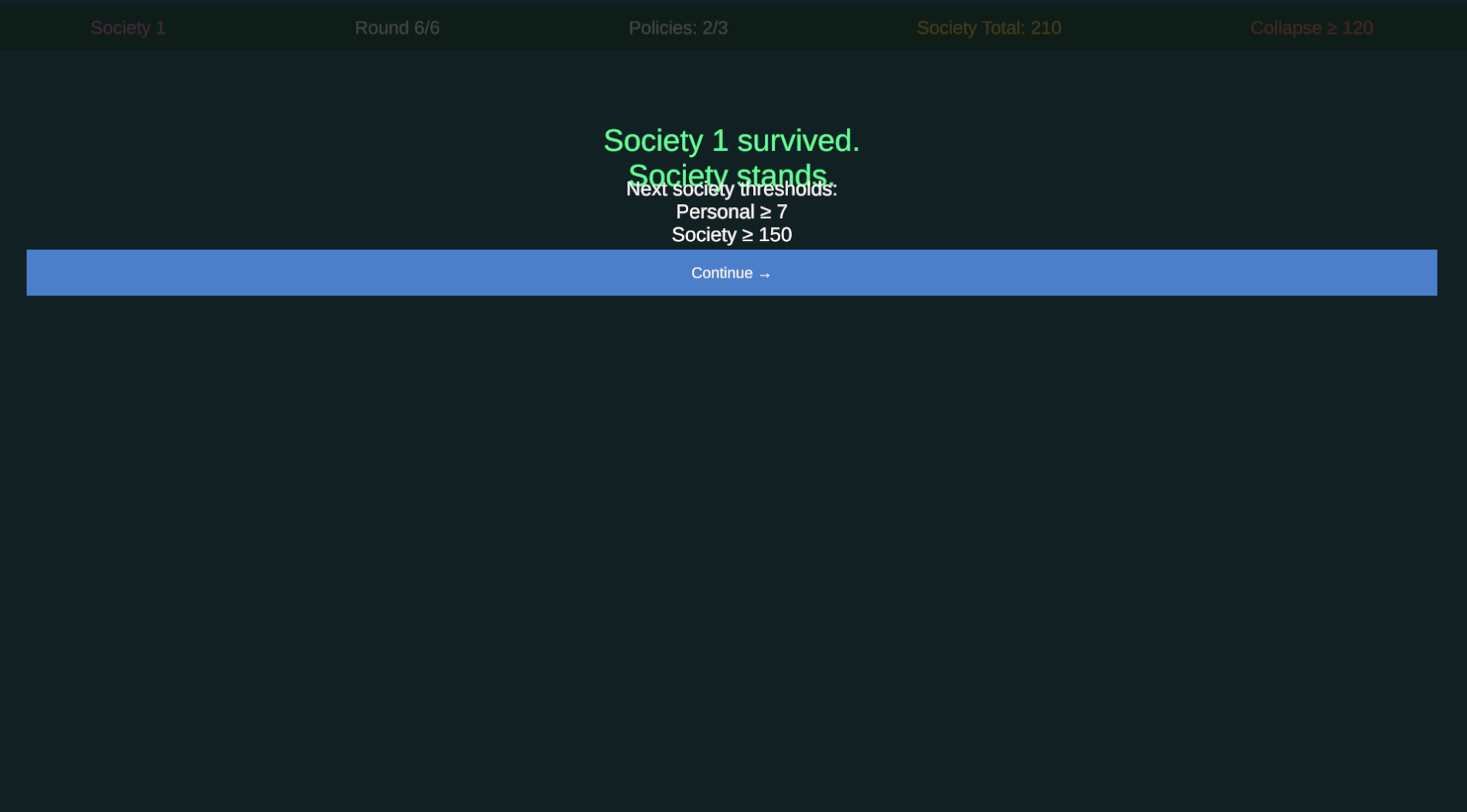

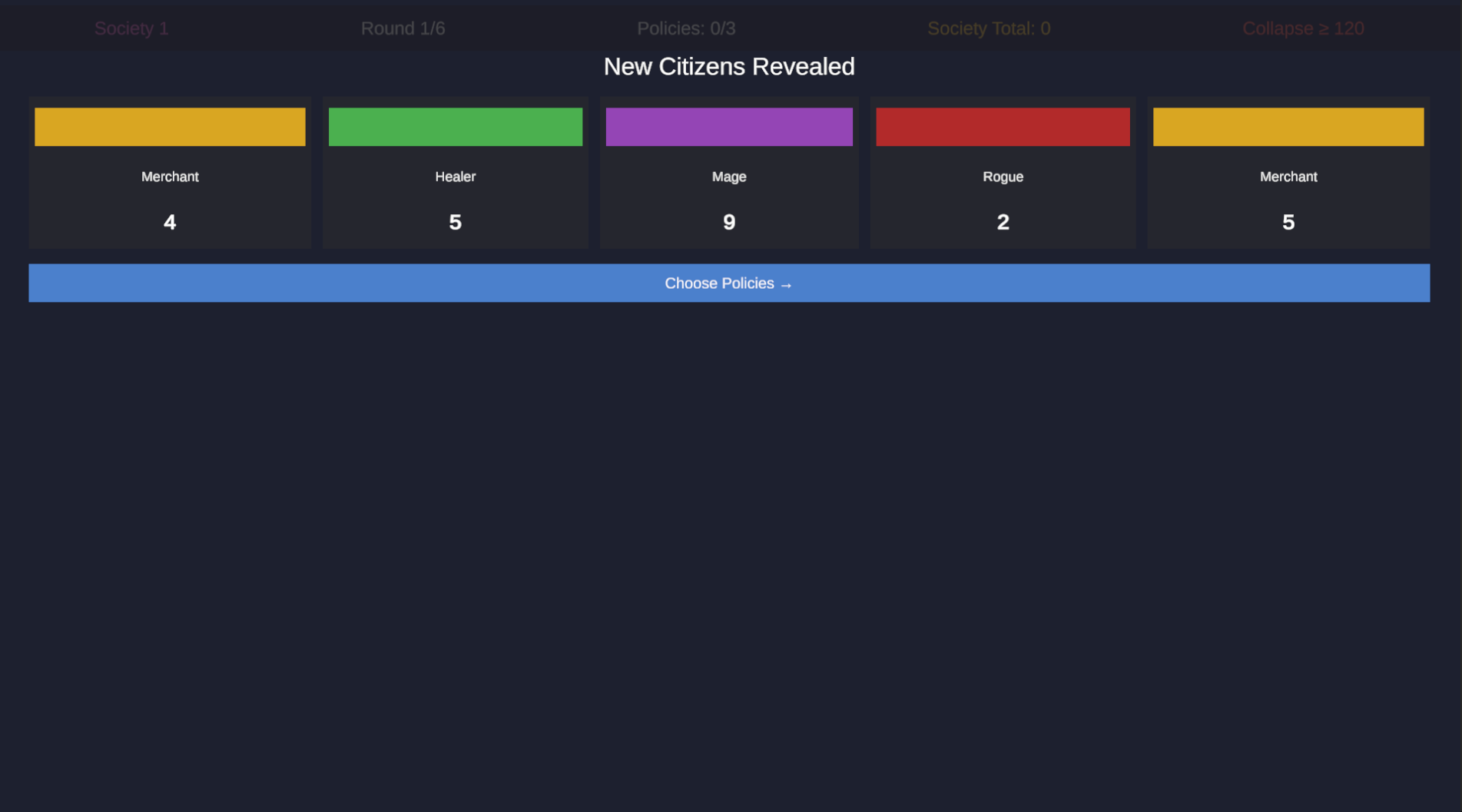
Game Play Video
Which of Rawls’s Designs Have I Simplified?
In the game’s setting, I have defined the legislators as members of the society. In contrast, Rawls’s parties are representatives. Representatives deliberate on principles but do not directly bear the consequences. However, I expect players to consider, while legislating, whether they themselves and society as a whole will survive when the game concludes. This design goal aims to reinforce some of Rawls’s moral weight, making players feel that the policy cards they choose must take into account both society and themselves.
Second, the veil is more of a symbolic veil. The veil presented by the game is not as thick as Rawls’s. Strictly speaking, players are not deprived of self-knowledge like Rawls’s parties (in fact, a video game would lack the ability to make players lose their memories). Players are aware that the society has certain labels and scores, but they do not know the specific evaluative implications of these elements within this particular society. For example, when players see Knights, I expect them to use their prior knowledge to infer what kind of people are typically called Knights. However, they do not know whether Knights are a minority or majority in this society, or whether they will be oppressed by policies or benefit from them.
Third, the game’s two objectives, PST (Personal Survival Threshold) and SCT (Society Collapse Threshold), are also simplified metrics. As a theory of political philosophy, Rawls focuses on characteristics such as class, talent, and life aspirations. These complex dimensions constitute a person’s multidimensional experience. However, within the game, these complex dimensions are compressed into a simple base score used for social settlement calculation. This is the cost of gamification driven simplification.
Given these simplifications, I still expect players to reflect on “justice as fairness” within the game, but I do not expect them to derive principles of justice. After all, players can only select three policy cards from the 22 I have provided. Beyond prompting players to consider what justice is, the game also raises questions more typical of a player’s perspective: “To what extent are you willing to stake your support on a particular group, and do you accept the consequences of the laws you personally crafted?”
The game intentionally resets the population for each run, and the veil falls anew each run. Retaining players’ policy cards tests whether their strategies remain stable across different population distributions, which corresponds to the condition of universality emphasized by Rawls.
Future Plans
Currently, the game is just a minimal playable prototype. It was designed to demonstrate the game’s core mechanics. The game has been fully implemented in Unity 6 (2D URP), featuring 6 classes, 22 policy cards (including 10 cross-role interaction cards), an infinite game loop, and the veil rise resolution phase.
The next step is to transform the game from a functional prototype into a fun, playable experience. First, I will add several successful endings that can also conclude the game, without telling players that they failed. Additionally, I plan to introduce more policy card designs, interactions between policy cards (such as three Scholar policy cards further influencing the population composition in the next round), as well as in-game progression (such as gaining additional policy card slots after winning multiple rounds) and out-of-game progression (such as players can unlock new classes and corresponding policy cards). I will also focus on balancing the game mechanics, refining UI animations, and potentially introducing random events (such as randomly triggered social crises that force players to address the crisis and adjust their policy choices).